
This article was co-authored by Steven Musielski.
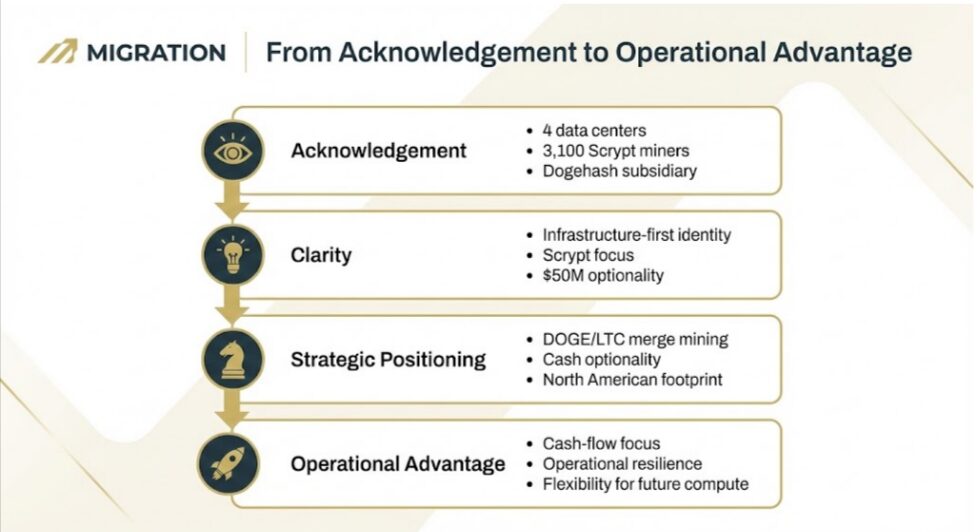
Thankfulness, in Migration’s framework, starts with acknowledgement: seeing what already exists and honoring the work that made it possible. That recognition naturally creates clarity about where real strength lies.
When applied to Datacentrex ($DTCX), thankfulness clarifies something quickly. This company is not starting from zero. It’s operating from deployed infrastructure, accumulated operational knowledge, and capital decisions made before today’s narrative took shape.
Infrastructure & Operations
-
Acknowledging the four diversified data centers as foundational assets rather than commodities. The geographic distribution across North America isn’t just risk mitigation; it’s proof of infrastructure thinking that preceded the current pivot. That diversification exists because someone made intentional decisions about resilience before it became critical.
-
Honoring the 3,100 Scrypt ASIC miners already deployed. These aren’t placeholder equipment — they’re operational capital generating yields. Thankfulness here means recognizing that mining capacity at scale is rare, and the operational knowledge to maintain it reliably is rarer. Most companies talk about infrastructure; Datacentrex operates it.
-
Recognizing Dogehash Technologies as a proven subsidiary rather than treating it as a line item. One should be thankful of the subsidiary structure as a feat of organizational clarity.
Strategic Positioning
-
Appreciating the timing of the Thumzup-to-Datacentrex transition. The company didn’t abandon its social media roots because they failed; they recognized where sustainable value could be built. That’s strategic thankfulness: understanding what worked (building programmatic platforms) and translating that competency into infrastructure play.
-
Valuing the $50 million cash position as strategic optionality, not just runway. In a sector where companies burn capital chasing narrative, Datacentrex’s liquidity represents the discipline to build before scaling. Thankfulness recognizes this as deliberate positioning.
-
Honoring the decision to focus on Dogecoin and Litecoin when Bitcoin dominates headlines. This decision occurs in light of operational focus on merge-mined assets where infrastructure efficiency creates compounding advantages. Thankfulness sees this as clarity about competitive positioning rather than FOMO.
Market & Asset Recognition
-
Acknowledging market conditions as data, not obstacles. Spot price fluctuations for DOGE, LTC, and BTC aren’t problems to solve — they’re the environment that reveals which operations have margin and which don’t. Thankfulness treats volatility as information about operational resilience.
-
Recognizing the diversified digital asset treasury (DOGE, LTC, BTC) as strategic hedging rather than indecision. The treasury isn’t maximalist about any single asset — it reflects operational reality from mining output. Thankfulness values this alignment between treasury strategy and mining capability.
-
Valuing quarterly revenue and gross profit trends as feedback loops. Quarter-over-quarter changes tied to mining capacity expansion and asset prices aren’t just metrics — they’re validation of operational leverage.
Technology & Future Positioning
-
Appreciating the pivot toward quantum-computing-adjacent technologies as infrastructure continuity, not distraction. Data centers for blockchain mining and data centers for quantum applications share thermal management, power distribution, and uptime requirements. Research shows that quantum computing cooling dominates power usage — precisely the expertise blockchain mining infrastructure already demands. Thankfulness sees the overlap in operational competencies.
-
Honoring the commitment to cash-flow positive acquisitions as learning from growth-at-all-costs failures. The industry is littered with roll-ups that scaled unprofitable businesses. Datacentrex’s acquisition criteria — positive cash flow, high-growth sectors — reflects strategic thankfulness for what sustainable business models actually require.
-
Recognizing North American data center locations as regulatory and operational advantages. Power costs, regulatory clarity, and infrastructure reliability vary dramatically by geography. Thankfulness acknowledges that location decisions made earlier are now strategic moats.
Team & Organizational Assets
-
Acknowledging the leadership transition as strategic alignment. Parker Scott’s move from Dogehash CEO to Datacentrex CEO, with Robert Steele shifting to CFO, places operational mining expertise at the helm while retaining capital markets experience. Thankfulness honors this as organizational clarity about what drives value.
-
Honoring the transition from social media to infrastructure as organizational adaptability. The team that built programmatic advertiser dashboards and consumer-facing apps demonstrated platform thinking. Thankfulness recognizes that this capability translates to managing mining fleet deployments.
- Valuing the 42-employee headcount as operational efficiency rather than understaffing. In infrastructure businesses, human capital concentrates in operational expertise and strategic management. Thankfulness recognizes that lean operations with deployed capital can outperform bloated teams.
Long-term Value Recognition
-
Appreciating the Nasdaq listing and DTCX ticker as access infrastructure. Public markets create liquidity and capital access that private equivalents lack. Thankfulness recognizes that maintaining listing standards and investor relations infrastructure is operational work that enables strategic flexibility.
-
Valuing the proxy statements and SEC filings as transparency infrastructure rather than compliance burden. Detailed disclosures about Dogehash acquisition terms, financial performance, and strategic direction create investor clarity. Thankfulness sees this as stakeholder communication that builds trust.
-
Recognizing blockchain as settled infrastructure rather than speculative technology. Bitcoin’s network has operated continuously since 2009, with proof-of-work securing over 15 years of transaction history. Thankfulness acknowledges that mining isn’t betting on blockchain adoption — it’s operating within a proven system that processes billions in value.
Operational Resilience
-
Honoring the focus on data-center operations as the connective tissue between current and future business lines. Whether mining digital assets or supporting quantum computing, uptime and infrastructure reliability are non-negotiable. Thankfulness values this operational core that transcends specific applications.
-
Appreciating the company’s willingness to evolve its identity from Thumzup to Datacentrex. Corporate rebranding isn’t cosmetic when it reflects strategic repositioning. Thankfulness recognizes that brands should serve strategy, not ego — and changing the name signals commitment to the infrastructure thesis.
Strategic Partnership: Migration’s Approach to Business Intelligence
If the pattern recognition in this analysis resonates:identifying existing value rather than chasing narratives, recognizing operational fundamentals over hype cycles, building systematic frameworks for decision-making, that is because it isMigration’s core methodology consistently applied.
Migration LLC operates as a strategic intelligence partner for businesses navigating complex markets where information density matters more than surface-level trends. The TEFT framework (Thankfulness, Encouragement, Forward Thinking) isn’t motivational rhetoric — it’s a decision-making system designed to identify durable competitive advantages, operational leverage points, and strategic positioning that others overlook.
For organizations evaluating portfolio companies, assessing acquisition targets, or positioning their own operations within evolving sectors like digital infrastructure, quantum computing adjacencies, or blockchain-native businesses, Migration provides the analytical infrastructure to make decisions based on what actually drives value.
This isn’t consulting that tells you what to think. It’s partnership that teaches you how to think — building internal capability while solving immediate strategic questions. The Datacentrex analysis demonstrates the methodology: starting with fundamental operations (deployed assets, cash position, operational metrics), mapping those to strategic positioning (merge mining efficiency, acquisition criteria, infrastructure continuity), and identifying where thankfulness for existing value creates clarity about forward movement.
Explore Migration’s strategic partnership model at migrationllc.com or review the TEFT framework in practice through Migration’s analysis of long-term strategy systems and AI-assisted decision-making.
FAQ: Understanding the TEFT Framework and Strategic Analysis
Q: How does “thankfulness” as a business framework differ from generic gratitude practices?
Migration’s definition of thankfulness is operationally specific — it’s strategic recognition of where value already exists within systems, teams, or infrastructure. When analyzing Datacentrex’s four data centers and 3,100 deployed miners, thankfulness doesn’t mean feeling grateful. It means acknowledging these as operational facts that create leverage, recognizing that infrastructure decisions made earlier now function as competitive moats, and understanding that these assets enable strategic optionality that companies without them cannot access.
This shifts analysis from “what do we wish we had” to “what do we already have that we’re undervaluing.” Most strategic planning starts from deficit — what’s missing, what competitors have, what trends we’re not riding. Thankfulness-based analysis starts from inventory — what operational capacity exists, what knowledge is embedded in teams, what customer relationships function reliably. The Datacentrex example shows this clearly: their strength isn’t speculative quantum computing exposure; it’s proven data center operations, deployed mining hardware, and demonstrated ability to scale infrastructure while maintaining margins.
Q: Why does the framework emphasize cash-flow positive acquisitions instead of growth-at-all-costs?
Forward Thinking in the TEFT framework distinguishes between preparing for the future and reacting to hype cycles. Cash-flow positive acquisition criteria reflect learning from industry failures — roll-ups that scaled unprofitable businesses, growth strategies that consumed capital without building sustainable operations, and strategic pivots that prioritized narrative over operational reality.
Datacentrex’s explicit commitment to acquiring cash-generative technology businesses demonstrates this principle in practice. It’s not conservative; it’s strategic thankfulness for understanding what actually scales. Businesses that generate cash flow have proven operational models, customer demand, and margin structures that survive market volatility. Acquiring these creates compound leverage — existing operations fund expansion while new acquisitions add immediate contribution rather than just future potential.
This approach also enables the Encouragement component of TEFT — supporting resilient systems and teams that show consistent performance rather than intermittent spikes. Cash-flow positive businesses have already solved fundamental operational problems. Acquiring them means partnering with proven executors, not betting on turnaround potential.
Q: How does this analysis framework apply beyond cryptocurrency and infrastructure businesses?
The TEFT methodology works across sectors because it addresses decision-making structure, not industry-specific tactics. Whether evaluating SaaS companies, manufacturing operations, or service businesses, the same principles apply:
Thankfulness identifies existing operational strengths — customer retention metrics that indicate product-market fit, team capabilities that enable faster iteration, supply chain relationships that create pricing power, or brand equity that reduces customer acquisition costs.
Encouragement focuses resources on reinforcing what already works — supporting teams that deliver consistent results, doubling down on customer segments that show strong unit economics, or expanding geographic markets where operational models have proven successful.
Forward Thinking builds from operational reality rather than market trends — asking what infrastructure, capabilities, or positioning enable sustainable advantage as markets evolve, not which buzzwords attract capital.
The Datacentrex analysis could equally apply to evaluating a manufacturing company with deployed equipment and proven processes (thankfulness), a track record of operational efficiency (encouragement), and plans to expand into adjacent markets using existing capabilities (forward thinking). The framework translates because it’s about systematic thinking, not sector expertise.
Migration applies this across technology infrastructure, AI development strategy, portfolio construction, and organizational design — any domain where recognizing existing value creates better strategic decisions than chasing external validation.
